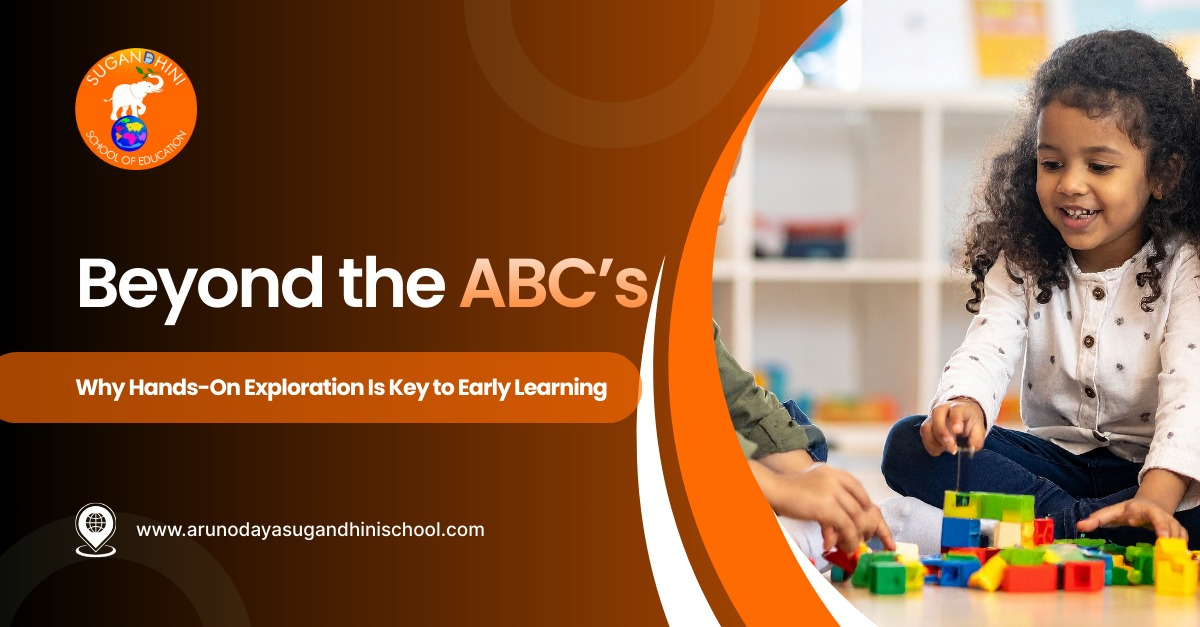
When parents think about early learning, alphabets, numbers and worksheets often come to mind. While these basics have their place, research consistently shows that young children learn best not by passive listening but by actively doing. This is why Montessori-inspired, play-based learning has become one of the most trusted approaches in early childhood education worldwide.
1.The Science: Why Children Learn Better by Doing
According to Harvard University’s Center on the Developing Child, 90% of a child’s brain develops by the age of five. During this critical period, the brain forms neural connections fastest when children engage in hands-on, sensory-rich experiences.
This is exactly how play-based learning supports brain development:
- When children touch, move, and explore, multiple areas of the brain activate at once
- Sensory play strengthens memory, attention and problem-solving skills
- Active learning creates stronger and longer-lasting neural pathways than passive instruction
Listening helps children learn what to think, while exploring teaches them how to think. That’s why going beyond the ABCs isn’t just a trend, it’s a science-backed foundation for meaningful early learning. At Arunodhaya Sugandhini, we believe that when children are given the freedom to explore, play and discover, they don’t just keep up, they flourish.
2.Why Exploration Is Essential in Early Learning
Children are natural explorers. They learn by asking “what happens if…?” and testing ideas through trial and error. The importance of exploration in early learning lies in allowing children to follow their curiosity instead of limiting them to fixed answers.
Research published in Early Childhood Research Quarterly found that children who regularly engage in exploratory play:
- Develop stronger critical-thinking skills
- Show better emotional regulation
- Are more confident in independent decision-making
In Montessori-inspired classrooms, exploration isn’t random, it’s purposeful. Learning materials are designed to encourage discovery, self-correction and independence, helping children understand concepts deeply rather than memorizing them temporarily.
3.Play-Based Learning Builds Skills for Life, Not Just School
One of the biggest advantages of play-based learning is that it nurtures the whole child, not just academic ability. Through guided and independent play, children naturally develop:
- Language and communication skills through storytelling and role play
- Social skills like cooperation, empathy and conflict resolution
- Fine and gross motor skills through hands-on activities
- Emotional resilience by learning from mistakes
A UNESCO report on early education highlights that children exposed to play-based environments are more likely to succeed academically in later years and show stronger adaptability in real-world situations.
4.Why Parents Can Trust This Approach
For parents, understanding the research behind hands-on learning brings clarity and confidence. A Montessori-inspired, play-based approach is not about “less structure” or “less learning.” It’s about developmentally appropriate learning that aligns with how young brains actually grow.
By focusing on exploration rather than rote instruction, children don’t just learn facts, they learn how to think, how to solve problems and how to love learning
6.In Simple Terms
Listening helps children learn what to think, while exploring teaches them how to think. That’s why going beyond the ABCs isn’t just a trend, it’s a science-backed foundation for meaningful early learning. At Arunodhaya Sugandhini, we believe that when children are given the freedom to explore, play and discover, they don’t just keep up, they flourish.