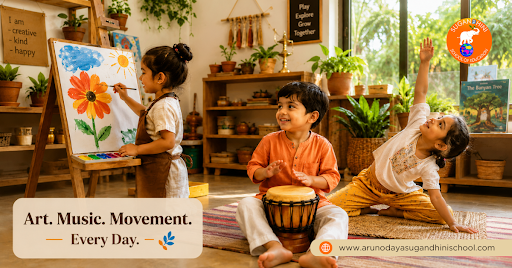
Imagine walking into a preschool classroom where one child is painting a colourful butterfly, another is singing along with classmates, while a third carefully balances across stepping stones during an outdoor activity. It may look like play, but every one of these moments is helping shape a child’s brain, confidence, creativity and social skills.Picture a three-year-old sitting cross-legged on the floor, brow furrowed, turning a wooden block this way and that, trying to figure out exactly where it fits. To a passing adult, it looks like ordinary play. To an early childhood educator, that quiet moment of concentration is a window into something remarkable: the development of spatial problem-solving, one of the most important cognitive skills a child can build.
These experiences are known as co-scholastic activities and they are just as important as learning letters and numbers.
In fact, 90% of a child’s brain develops before the age of five, making the preschool years one of the most critical stages for holistic development. During this period, experiences involving art, music, movement, and creative exploration help build neural pathways that support lifelong learning.
At Arunodaya Sugandhini, co-scholastic activities are thoughtfully woven into the daily curriculum because educating the whole child goes beyond academics; it means nurturing creativity, confidence, emotional well-being, and curiosity.
What Are Co-Scholastic Activities?
Co-scholastic activities are structured learning experiences that complement classroom academics by developing children’s creative, physical, emotional, and social abilities.
- Art and Craft
- Music and Singing
- Dance and Movement
- Storytelling
- Puppet Shows
- Clay Modelling
- Outdoor Play
- Nature Exploration
- Role Play
Rather than distracting children from academics, these activities strengthen the very skills that make academic learning possible.
Why Are Co-Scholastic Activities So Important?
According to the Center on the Developing Child at Harvard University, early experiences shape the architecture of the developing brain. Activities involving movement, creativity, and positive social interaction create strong neural connections that influence learning throughout life.
Children who regularly participate in co-scholastic activities often demonstrate:
- Better communication skills
- Higher creativity
- Improved concentration
- Stronger emotional regulation
- Better teamwork and collaboration
- Greater confidence
These aren’t just classroom skills, they’re life skills.
At Arunodaya Sugandhini, every activity is designed to help children develop intellectually while also becoming confident, compassionate, and independent individuals.
Art Encourages Creativity and Critical Thinking
When children paint, draw, or create with clay, they are doing much more than making artwork.
- Strengthen fine motor skills
- Improve hand-eye coordination
- Develop imagination
- Learn problem-solving
- Build confidence through self-expression
Did You Know?
Research published by the National Endowment for the Arts found that children involved in arts-based learning often demonstrate higher levels of creative thinking, engagement, and confidence than those with limited exposure to creative activities.
Open-ended art activities also teach children that there is no single “correct” answer encouraging innovation from an early age.
Music Helps Build Smarter Learners
Music is one of the most powerful tools in early childhood education.
Studies show that musical activities stimulate multiple areas of the brain simultaneously.
- Improve vocabulary
- Recognise sounds and patterns
- Strengthen memory
- Enhance listening skills
- Develop emotional awareness
At Arunodaya Sugandhini, songs, rhymes, rhythm games and musical storytelling are integrated into everyday classroom experiences to make learning joyful and memorable.
Movement Supports Healthy Brain Development
Children are naturally active learners.
Running, dancing, climbing, balancing, and outdoor games all contribute to healthy physical and cognitive development.
Movement activities improve:
- Gross motor skills
- Balance and coordination
- Spatial awareness
- Concentration
- Self-confidence
Fun Fact
The World Health Organization (WHO) recommends that children aged 3 – 4 years should spend at least 180 minutes each day engaged in various physical activities, including energetic play, to support healthy growth and development.
Active children are often better prepared to focus during quieter classroom activities.
How Co-Scholastic Activities Support Academic Success
Many parents think academic success begins with books.
In reality, it begins with experiences.
Here’s how co-scholastic activities strengthen classroom learning:
- Painting develops pencil control and handwriting readiness.
- Music improves phonics, listening, and language development.
- Dance enhances coordination and body awareness.
- Storytelling expands vocabulary and communication skills.
- Clay modelling strengthens finger muscles needed for writing.
- Nature exploration encourages curiosity and observation.
When children enjoy learning through multiple experiences, they become more confident learners.
Beyond Academics: Building Life Skills
One of the greatest advantages of co-scholastic activities is their ability to develop lifelong skills.
- Work as part of a team
- Solve problems independently
- Express their ideas confidently
- Respect others’ opinions
- Build resilience through creative exploration
How Parents Can Continue Learning at Home
Learning doesn’t stop when school ends.
Parents can encourage co-scholastic learning through simple activities like:
- Painting together
- Singing nursery rhymes
- Reading stories
- Gardening
- Playing outdoor games
- Building with blocks
- Dancing to music
- Exploring nature
Even everyday experiences become valuable learning opportunities.
Conclusion
Co-scholastic activities are not “extra” activities; they are an essential part of a child’s development. Art, music, movement, storytelling and creative exploration help children build the confidence, creativity, communication and problem-solving skills that support lifelong learning.
At Arunodaya Sugandhini, these experiences are thoughtfully integrated into every school day, ensuring that children grow academically, socially, emotionally and physically in a nurturing environment.
When children are encouraged to create, explore, move, and express themselves every day, they don’t just become better students, they become happier, more confident individuals.
If you’re looking for a preschool that values holistic development, visit Arunodaya Sugandhini and experience how co-scholastic activities help shape confident learners and future-ready children.