
4 Simple, Everyday Toys That Unlock Advanced Spatial Problem-Solving in Early Childhood
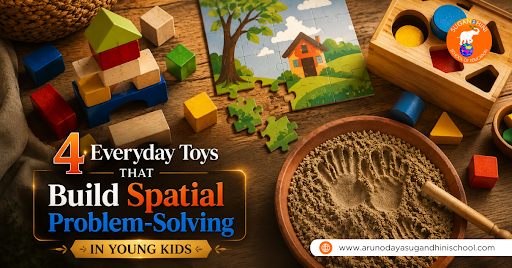
Picture a three-year-old sitting cross-legged on the floor, brow furrowed, turning a wooden block this way and that, trying to figure out exactly where it fits. To a passing adult, it looks like ordinary play. To an early childhood educator, that quiet moment of concentration is a window into something remarkable: the development of spatial problem-solving, one of the most important cognitive skills a child can build.
Spatial thinking, the ability to understand shapes, distances, directions and how objects relate to one another forms the foundation for success in mathematics, science, reading and even everyday decision-making. The best part? You don’t need expensive gadgets or complicated learning tools to develop these skills. Some of the most effective resources are simple, timeless toys that encourage children to explore, experiment and imagine.
Here are four everyday toys that naturally strengthen spatial problem-solving skills.
1. Building Blocks: The Original Spatial Classroom
Building blocks have remained a favourite in early childhood classrooms for generations and for good reason. Every time children stack, balance, sort or rebuild blocks, they are learning to predict outcomes, compare sizes and understand how different pieces fit together.
What Spatial Skills Do Blocks Develop?
- Mental rotation imagining how a shape looks when turned
- Spatial visualisation planning a structure before building it
- Part-whole reasoning understanding how individual pieces create a complete structure
- Size and proportion awareness comparing height, width and balance
Instead of encouraging children to copy a design, ask open-ended questions such as:
- “What do you think will happen if you place the biggest block on top?”
- “Can you build a tower taller than your teddy bear?”
2. Jigsaw Puzzles: Training the Mind's Eye
A jigsaw puzzle may look simple, but it challenges several areas of a child’s brain at once. Children must imagine the finished picture, compare pieces, recognise patterns and mentally rotate shapes before placing them correctly.
How Puzzles Support Early Learning
- Improve concentration and attention span
- Strengthen fine motor skills
- Develop pattern recognition
- Encourage logical thinking and perseverance
- Build confidence through independent problem-solving
Begin with larger puzzles for toddlers and gradually introduce more complex designs as their confidence grows. Nature-themed puzzles or familiar everyday scenes also provide wonderful opportunities to build vocabulary alongside spatial awareness.
3. Shape Sorters and Geometry Toys: Introducing Geometry Through Play
Long before children learn about geometry in school, shape sorters introduce them to circles, triangles, squares, and other forms through hands-on exploration.
Every time a child turns a shape until it fits perfectly into its matching slot, they are strengthening important cognitive abilities.
Why Shape Sorters Are So Effective
| Skill Area | What the Child Learns | Future Academic Benefit |
|---|---|---|
| Shape Recognition | Identifying shapes by sight and touch | Geometry and letter recognition |
| Mental Rotation | Rotating shapes to fit correctly | Mathematics and spatial reasoning |
| Trial and Error | Testing different solutions | Scientific thinking and problem-solving |
| Categorisation | Grouping similar objects | Language development and data handling |
4. Sand and Clay Play: Learning Through Hands-On Exploration
Few activities are as valuable and enjoyable as playing with sand, clay or playdough.
When children roll, flatten, mold, scoop and reshape these materials, they are discovering concepts like volume, symmetry, balance and transformation without even realizing it.
Spatial Skills Developed Through Sand and Clay
- Understanding volume and capacity
- Exploring symmetry and proportion
- Learning that materials can change shape while remaining the same amount
- Building rich spatial vocabulary such as inside, outside, above, below, narrow and wide
These experiences become even more meaningful in outdoor learning environments where children can freely explore natural materials.
Signs Your Child May Need More Active Play
Children who are not getting enough movement opportunities may:
- Struggle to concentrate
- Become restless during learning activities
- Show poor coordination or balance
- Experience frustration more easily
- Prefer excessive screen time over physical activity
These experiences become even more meaningful in outdoor learning environments where children can freely explore natural materials.
This simple idea perfectly captures why hands-on experiences remain some of the most powerful learning opportunities during early childhood.
Bringing It All Together: Play Is Powerful Learning
What connects building blocks, puzzles, shape sorters and sand or clay is that they all encourage children to think, experiment and solve problems independently.
Rather than simply memorising information, children become architects, engineers, artists and scientists as they build, test ideas, make mistakes and discover solutions.
A Quick Reference Guide for Parents and Educators
| Toy | Ideal Age Range | Key Spatial Skill | Bonus Developmental Benefit |
|---|---|---|---|
| Building Blocks | 18 months – 6 years | Spatial visualisation, part-whole reasoning | Creativity and engineering thinking |
| Jigsaw Puzzles | 2 – 7 years | Mental rotation, pattern recognition | Persistence and fine motor skills |
| Shape Sorters | 12 months – 4 years | Shape recognition and trial-and-error reasoning | Geometry readiness and categorisation |
| Sand and Clay | 18 months – 8 years | Volume, transformation, spatial language | Sensory development and creativity |
Give Your Child the Gift of Spatial Thinking
You don’t need expensive educational toys to help your child become a confident thinker. Sometimes, the simplest toys provide the richest learning experiences.
Pull out a set of blocks. Solve a puzzle together. Let your child play with clay or dig in the garden. Ask thoughtful questions, encourage curiosity and celebrate every discovery. What may appear to be simple play today is building the thinking skills your child will rely on for years to come.
More Posts
Screen Time Effects on Child Speech: Interactive or Passive?
Screen Time Effects on Child Speech: Interactive or Passive? If

Best Preschool in Bellary: Why Arunodhaya Sugandhini Is the First Choice for Early Childhood Education
Best Preschool in Ballari: Why Arunodhaya Sugandhini School Of Education
Co-Scholastic Activities Explained: Why Art, Music and Movement Belong in Every Preschool Day
Co-Scholastic Activities Explained: Why Art, Music and Movement Belong in
The Science Behind Active Play: How Movement Improves Learning in Young Children
The Science Behind Active Play: How Movement Improves Learning in