
Screen Time Effects on Child Speech: Interactive or Passive?
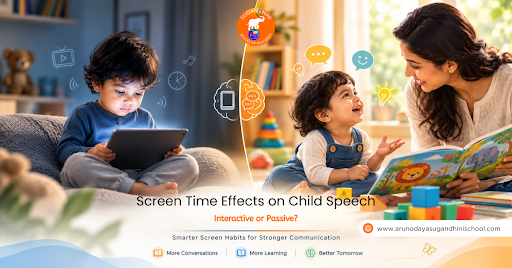
If your toddler has ever sat quietly in front of a tablet for an hour while you finally got dinner on the table, you are not alone. Screens have become a familiar part of family life, and for good reason they can be calming, entertaining, and occasionally educational. But as children spend more time watching and less time talking, many parents are starting to ask a very important question: what are the real screen time effects on child speech and what can we actually do about them?
Understanding the Two Types of Screen Time
Not all screen time is created equal. Before exploring solutions, it helps to understand the two main types of screen time your child is likely experiencing.
Caring and Experienced Educators
This is the type of screen time most children experience. Passive screen time includes watching cartoons, streaming shows or autoplay videos without any meaningful interaction. Children receive language input, but there is no conversation, no response expected and no real-time engagement.
Interactive Screen Time
Interactive screen time encourages children to participate. It may involve answering questions in an educational app, touching the screen to complete activities, or joining a video call with family members. While it is not a substitute for face-to-face interaction, it more closely resembles the conversational exchanges that support language development.
Understanding this distinction helps parents make more informed choices about how technology fits into their child’s daily routine.
How Screen Time Affects Language Development
Language develops through interaction. Children learn to speak by hearing words in meaningful contexts, watching facial expressions, responding to conversations and receiving feedback. Speech-language professionals often describe this process as serve-and-return interaction, where each conversation builds new language skills.
Passive screen time interrupts this natural learning process. A screen may talk, but it cannot truly listen. It cannot pause when a child is confused, adapt its language, or respond enthusiastically when a toddler attempts a new word. As passive viewing increases, the number of meaningful conversational exchanges naturally decreases.
This explains how screen time affects language development. The issue is often not the educational content itself but what children are missing while watching. Every hour spent passively viewing screens replaces valuable opportunities for:
- Face-to-face conversations
- Reading books together
- Pretend play
- Singing songs
- Storytelling
- Everyday family interactions
During the first five years of life, the brain is especially prepared for language learning. Rich, responsive conversations during this period are essential for reaching speech and language milestones.
Can Too Much Screen Time Cause Speech Delay?
This is one of the most common concerns parents have.
The honest answer is that it depends, but screen habits do matter.
Research consistently suggests that excessive passive screen time in toddlers and preschool-aged children is associated with slower language development. However, screen time is rarely the only contributing factor. The overall language environment determines how much parents talk, read, sing and respond to their child plays an equally important role.
When screens consistently replace real conversations during the early years, children’s opportunities to practice language become limited. This is particularly important for children under two years of age, where excessive passive viewing has been associated with:
- Smaller vocabulary growth
- Fewer conversational attempts
- Reduced social communication
- Delayed speech milestones
The encouraging news is that young children’s brains remain highly adaptable. Increasing meaningful conversations and reducing passive viewing can significantly improve language development over time.
Interactive vs. Passive: A Quick Comparison
| Feature | Passive Screen Time | Interactive Screen Time |
|---|---|---|
| Child’s Role | Viewer | Active Participant |
| Language Input | One-way | Two-way or Guided |
| Conversational Turns | None | Some |
| Speech Development Value | Low | Moderate (Best with Adult Participation) |
| Best Used For | Limited, Supervised Entertainment | Guided Educational Activities & Video Calls |
Practical Ways to Counteract the Screen Time Effect on Early Speech
You do not need to eliminate screens completely. Instead, focus on increasing language-rich interactions throughout your child’s day.
1. Talk During and After Screen Time
Whenever possible, watch with your child.
Describe what is happening, ask simple questions, and encourage responses.
Examples include:
- “What animal is that?”
- “Can you find the red ball?”
- “What do you think happens next?”
These conversations transform passive viewing into a shared learning experience.
2. Use Screen Time as a Starting Point
Continue the learning after the screen is turned off.
You might:
- Draw favourite characters.
- Act out scenes using toys.
- Ask your child to retell the story.
- Sing songs from the programme together.
This simple extension helps reinforce vocabulary and conversation skills while reducing the negative screen time effects on child speech.
3. Replace One Screen Session Each Day
Small changes create lasting results.
Instead of one daily screen session, choose a language-rich activity like:
- Reading picture books
- Singing nursery rhymes
- Building blocks together
- Cooking while describing each step
- Going for a nature walk and naming objects
These everyday moments provide countless opportunities for conversation.
4. Choose Video Calls Over Passive Viewing
If your child is using a device, video conversations with grandparents, relatives, or friends are far more beneficial than passive videos.
Video calls encourage children to:
- Listen
- Respond
- Ask questions
- Read facial expressions
- Participate in real conversations
5. Create Screen-Free Family Times
Certain parts of the day naturally encourage conversation.
Consider making these screen-free:
- Family mealtimes
- Bedtime routines
- Car rides
- Outdoor playtime
These moments become opportunities for storytelling, questions and meaningful family interaction.
6. Follow Your Child's Lead During Play
Children learn language best when adults join their interests.
Instead of directing play, observe and comment naturally.
For example:
“You’re building a tall tower!”
“The blue block is on top.”
“Oops! It fell down.”
Simple, responsive language like this helps children connect words with experiences while expanding vocabulary.
This child-led approach is one of the core principles encouraged at Arunodhaya Sugandhini School of Education, where learning is built around curiosity, communication, and meaningful engagement.
A Note on Guilt
Modern parenting includes technology.
If your child has had more screen time than you intended, there is no need to feel guilty.
What matters most is what happens moving forward.
Small daily improvements, more conversations, shared reading, outdoor play and responsive interactions can have a meaningful impact on speech and language development over time.
When Should You Seek Professional Support?
If you have reduced passive screen time, increased daily conversations and your child is still not reaching expected speech milestones, consider consulting a qualified speech-language pathologist.
Speech delays can result from many different factors and screen time is only one part of the picture.
Early identification and intervention often lead to better long-term outcomes.
Parents should trust their instincts and seek professional guidance whenever concerns arise.
Final Thoughts
Understanding how screen time affects language development is not about eliminating technology, it is about creating a healthy balance between digital experiences and meaningful real-world interactions. While screens can be a useful educational tool when used appropriately, they should never replace the conversations, storytelling, reading, imaginative play, and social experiences that help children grow into confident communicators and lifelong learners.
By partnering with parents to promote balanced screen habits and meaningful learning experiences, we help children build a strong foundation for success both inside and outside the classroom.
More Posts

Best Preschool in Bellary: Why Arunodhaya Sugandhini Is the First Choice for Early Childhood Education
Best Preschool in Ballari: Why Arunodhaya Sugandhini School Of Education

Co-Scholastic Activities Explained: Why Art, Music and Movement Belong in Every Preschool Day
Co-Scholastic Activities Explained: Why Art, Music and Movement Belong in

4 Simple, Everyday Toys That Unlock Advanced Spatial Problem-Solving in Early Childhood
4 Simple, Everyday Toys That Unlock Advanced Spatial Problem-Solving in

The Science Behind Active Play: How Movement Improves Learning in Young Children
The Science Behind Active Play: How Movement Improves Learning in