
From Sound to Story: How Phonics Makes Reading Meaningful for Children
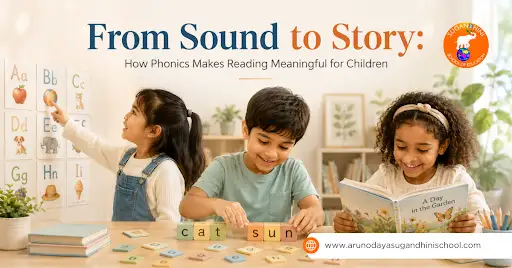
By building a strong relationship between spoken and written words, phonics empowers young learners to decode unfamiliar words independently rather than simply memorizing them. As educator and literacy advocate Louisa Moats famously stated:
Through structured phonics instruction, Arunodaya Sugandhini helps young learners build the foundations they need to succeed not only in reading but throughout their academic journey.
Understanding the Foundation: What Makes Phonics Effective
Phonics operates on the principle that children learn to read by understanding the relationship between letters and their corresponding sounds. This systematic approach breaks down the complexity of language into manageable components, allowing children to decode unfamiliar words independently.
The effectiveness of phonics lies in its structured progression. Children begin by learning individual letter sounds, then blend these sounds to form simple words, gradually building their confidence and ability to tackle more complex texts. This methodical approach ensures that students develop a solid foundation before moving to advanced reading skills.
The Science Behind Sound-Symbol Connections
Visual Learning Methods in Phonics Instruction
| Visual Method | Application | Benefits |
|---|---|---|
| Letter-Picture Associations | Connecting letters with familiar objects | Creates memorable visual anchors |
| Color Coding | Using different colors for vowels and consonants | Helps pattern recognition |
| Movement Integration | Hand gestures for different sounds | Engages kinesthetic learners |
| Story Illustrations | Visual narratives supporting text | Provides context clues |
Activity-Based Literacy Learning Through Phonics
Practical Activities That Build Phonics Skills
- Sound Scavenger Hunts: Children search for objects that begin with specific sounds, reinforcing letter-sound connections through exploration
- Rhyme Creation Games: Students generate rhyming words, developing phonological awareness while having fun
- Letter Building Exercises: Using manipulatives to construct letters helps children understand letter formation and recognition
- Story Creation Projects: Children write simple stories using newly learned phonics patterns, applying skills in meaningful contexts
These activities transform phonics from a drill-based subject into an exciting adventure where children discover the joy of reading through play and exploration.
Connecting Phonics to Real-World Learning
Cross-Curricular Phonics Applications
Building Confidence Through Systematic Progression
The Confidence-Building Cycle
- Sound Recognition: Children identify individual letter sounds with accuracy
- Blending Practice: Students combine sounds to form simple words
- Word Recognition: Familiar patterns help children read new words independently
- Story Comprehension: Confident decoding skills allow focus on meaning and enjoyment
- Independent Reading: Children choose to read for pleasure and learning
This progression ensures that children never feel overwhelmed while continuously challenging them to grow their skills.
Supporting Different Learning Styles
Every child learns differently, and effective phonics instruction recognizes these individual learning styles. At Arunodaya Sugandhini, we use a combination of auditory, visual, and hands-on learning techniques to help every child build strong reading skills.
Research shows that multisensory learning approaches improve literacy development by engaging multiple areas of the brain, helping children retain information more effectively.
Studies also indicate that children learn to read more successfully when teaching methods are adapted to their individual needs and learning preferences.
From Decoding to Meaning-Making
The ultimate goal of phonics instruction extends far beyond mechanical decoding. When children master phonics skills, they free their cognitive resources to focus on comprehension, critical thinking, and creative interpretation of texts.
This transition from sound recognition to story understanding represents the true power of phonics education. Children who once struggled with individual letters become confident readers who engage with complex narratives, learn from informational texts, and express their own ideas through writing.
Nurturing Lifelong Readers
Quality phonics instruction does more than teach children how to decode words; it nurtures confident, lifelong readers who see books as gateways to adventure, knowledge and personal growth. At Arunodaya Sugandhini, we believe that when children understand the patterns and structure of language, they gain the confidence to explore new ideas and tackle unfamiliar texts independently.
Research consistently supports the effectiveness of phonics-based learning. Studies have shown that children who receive systematic phonics instruction in their early years develop stronger reading accuracy, fluency, and comprehension skills than those who do not. In fact, literacy experts widely recognize phonics as one of the most effective foundations for early reading success.
As renowned children’s author Dr. Seuss once said:
Ready to transform your child’s reading journey?
More Posts
Screen Time Effects on Child Speech: Interactive or Passive?
Screen Time Effects on Child Speech: Interactive or Passive? If

Best Preschool in Bellary: Why Arunodhaya Sugandhini Is the First Choice for Early Childhood Education
Best Preschool in Ballari: Why Arunodhaya Sugandhini School Of Education

Co-Scholastic Activities Explained: Why Art, Music and Movement Belong in Every Preschool Day
Co-Scholastic Activities Explained: Why Art, Music and Movement Belong in
4 Simple, Everyday Toys That Unlock Advanced Spatial Problem-Solving in Early Childhood
4 Simple, Everyday Toys That Unlock Advanced Spatial Problem-Solving in