
Why Parents in 2026 Are Choosing Schools That Focus on Life Skills & Emotional Growth
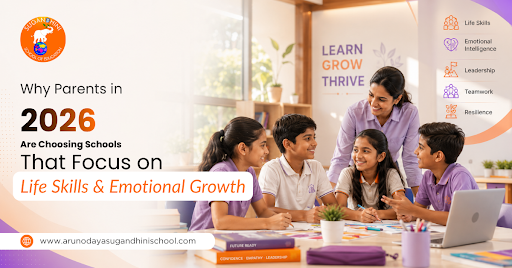
For decades, the standard playbook for academic success was clear-cut: high test scores, immaculate report cards, and a hyper-focus on rote memorisation. However, the educational landscape has undergone a massive paradigm shift. As we navigate 2026, parents are realising that academic honours alone are no longer enough to guarantee a child’s long-term success or happiness in an increasingly volatile, automated, and interconnected world.
This deep dive into modern education explores the shifting priorities of parents, highlights the profound importance of life skills in education and explains why a balanced approach to life skills and emotional growth for students is becoming a key factor in school selection.
The Shift in Parental Priorities: From Test Scores to Human Capabilities
The acceleration of artificial intelligence, remote workplaces, and global digital networks has completely redefined what it means to be “career-ready.” While information is readily accessible through technology, human capabilities such as empathy, leadership, creativity and critical thinking remain irreplaceable.
Parents in 2026 understand that traditional schooling models often produce academically capable students who may still struggle with real-world challenges. By prioritising emotional growth in schools, families are ensuring that children learn how to navigate both personal and professional challenges with confidence.
The Dual Pillars of Modern Success
- Academic Foundation: Technical literacy, research skills, and subject knowledge
- Holistic Development – Emotional regulation, resilience, communication, and adaptability
Why Life Skills Matter More Than Ever
According to leading workforce studies, employers increasingly value soft skills such as communication, problem-solving, teamwork and emotional intelligence alongside technical expertise.
The importance of life skills in education extends far beyond the classroom. These skills help students:
- Build confidence and independence
- Make informed decisions
- Adapt to changing circumstances
- Develop healthy relationships
- Manage stress effectively
- Prepare for future careers
In a rapidly evolving world, life skills provide a foundation for lifelong success.
Defining the Core Focus: Life Skills and Emotional Growth for Students
When discussing holistic education, two critical pillars emerge.
1. Life Skills Education
Life skills education equips students with practical competencies that support everyday decision-making and independence.
Examples include:
- Financial literacy and budgeting
- Time management
- Public speaking
- Leadership development
- Digital citizenship
- Critical thinking and problem-solving
- Collaboration and teamwork
For example, a student who learns budgeting principles in school is better prepared to manage finances as an adult. Likewise, students involved in project-based learning often develop stronger leadership and teamwork abilities.
2. Emotional Growth and Intelligence
Emotional intelligence helps students understand and manage their emotions while building positive relationships with others.
Schools focused on emotional growth often teach:
- Emotional regulation
- Active listening
- Conflict resolution
- Stress management
- Self-awareness
- Empathy and compassion
By combining life skills education with emotional development, schools such as Arunodaya Sugandhini create supportive environments where students can thrive academically, socially and personally.
Why Parents Are Choosing Life Skills Focused Schools
A Response to Growing Mental Health Concerns
The digital era has introduced new pressures for young people, from social media comparison to information overload. Parents increasingly seek schools that actively support student wellbeing through emotional learning programmes, mindfulness practices and positive school cultures.
Preparing Students for an Unpredictable Future
Many future careers have yet to be created. As a result, adaptability and lifelong learning have become more important than memorising information.
| Traditional Education Focus | Modern Life Skills Focus |
|---|---|
| Memorisation | Critical thinking |
| Individual competition | Collaboration |
| Fixed outcomes | Adaptability |
| Test performance | Real-world readiness |
The importance of life skills in education lies in teaching students how to learn, adapt, and grow throughout their lives.
Key Life Skills Schools Should Teach in 2026
Schools preparing students for future success should focus on developing:
- Communication and public speaking
- Critical thinking
- Financial literacy
- Leadership skills
- Digital responsibility
- Time management
- Collaboration
- Creativity
- Emotional intelligence
- Decision-making
These competencies help students become confident, capable individuals both inside and outside the classroom.
What Parents Should Look for in a School
When evaluating educational institutions, parents should consider whether the school:
- Promotes emotional wellbeing
- Encourages leadership opportunities
- Integrates life skills into the curriculum
- Supports project-based and experiential learning
- Teaches digital literacy and online responsibility
- Develops communication and teamwork skills
- Provides strong pastoral care and student support
Schools that prioritise these areas are often better equipped to prepare students for future success.
The Tangible Benefits of a Life Skills-Centred Approach
When schools combine academic excellence with practical life preparation, students gain significant advantages.
Elevated Academic Performance
Research consistently shows that emotionally secure students are better equipped to focus, learn, and perform academically.
Better Communication and Conflict Resolution
Students develop the ability to express themselves effectively, resolve disagreements constructively, and build stronger relationships.
Increased Confidence and Independence
Learning practical skills such as budgeting, public speaking, and project management builds self-confidence and encourages independence.
Greater Resilience
Students learn how to manage setbacks, embrace challenges, and adapt to changing circumstances skills that are invaluable throughout life.
Quick School Evaluation Checklist
Before choosing a school, ask yourself:
- Does the school teach life skills alongside academics?
- Are emotional wellbeing programmes available?
- Does the curriculum encourage critical thinking?
- Are leadership opportunities provided?
- How does the school support student mental health?
- Are communication and teamwork actively encouraged?
If the answer is “yes” to most of these questions, the school is likely preparing students for long-term success.
Future Skills Students Will Need Beyond 2030
As technology continues to evolve, the following skills are expected to become even more valuable:
- Emotional intelligence
- Creativity
- Leadership
- Adaptability
- Digital literacy
- Collaboration
- Problem-solving
- Ethical decision-making
Schools that develop these competencies today are helping students prepare for tomorrow’s opportunities.
Conclusion
The educational benchmark of the future is no longer measured solely by examination results; it is defined by how effectively students can navigate life beyond the classroom.
When evaluating schools in 2026, look beyond grades and rankings and choose an environment that prepares your child not just for exams, but for life.
Ready to give your child a strong foundation for lifelong success?
More Posts
Screen Time Effects on Child Speech: Interactive or Passive?
Screen Time Effects on Child Speech: Interactive or Passive? If

Best Preschool in Bellary: Why Arunodhaya Sugandhini Is the First Choice for Early Childhood Education
Best Preschool in Ballari: Why Arunodhaya Sugandhini School Of Education
Co-Scholastic Activities Explained: Why Art, Music and Movement Belong in Every Preschool Day
Co-Scholastic Activities Explained: Why Art, Music and Movement Belong in
4 Simple, Everyday Toys That Unlock Advanced Spatial Problem-Solving in Early Childhood
4 Simple, Everyday Toys That Unlock Advanced Spatial Problem-Solving in