
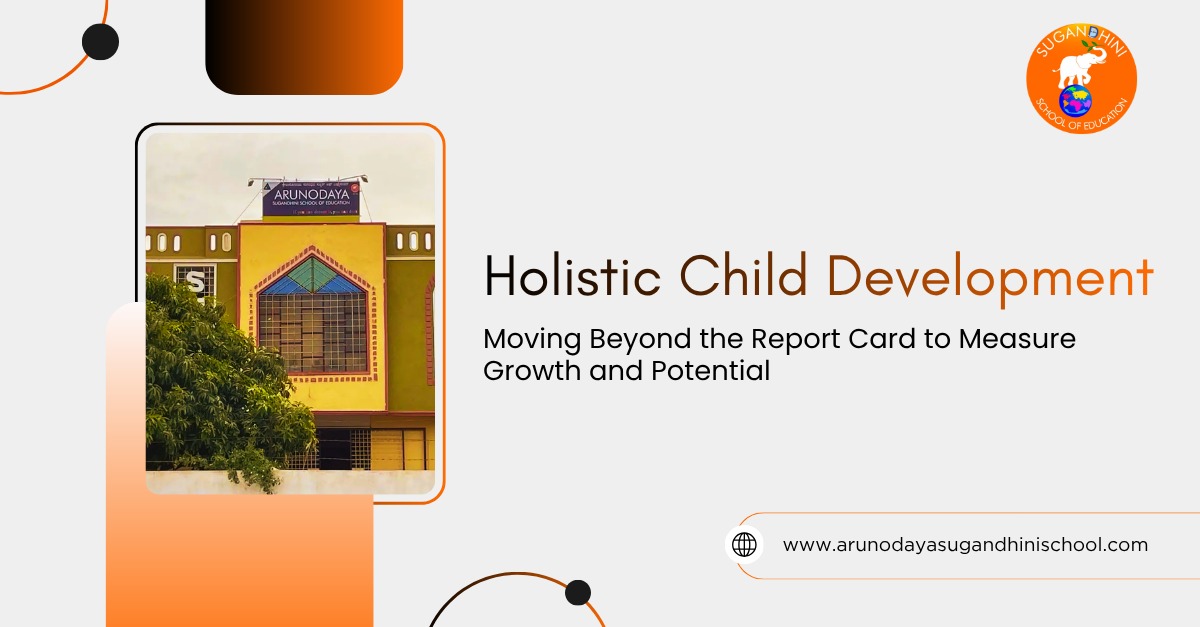
Holistic Child Development: Moving Beyond the Report Card to Measure Growth and Potential
Why Grades Alone Don’t Tell the Full Story
Let’s start with a simple question: if a child scores 95% in exams, does that automatically mean they are creative, confident, or emotionally strong? Not really. Traditional report cards focus heavily on marks and percentages, but they fail to capture the full picture of a child’s development. Think of grades as a “highlight reel” rather than the full movie; they show outcomes but miss the effort, mindset, and growth behind them.
The World Economic Forum also highlights that problem-solving, emotional intelligence and collaboration are among the most essential future skills. If we continue to measure only academic performance, we risk preparing children for a world that no longer exists.
The Overemphasis on Academic Achievement
The education system has long rewarded students for memorization and test performance. But here’s the catch: memorizing information doesn’t equal understanding it. Students often study to pass exams rather than to learn, which leads to shallow knowledge retention.
A survey conducted across multiple schools found that over 70% of students experience stress related to exams and grades. That’s a huge number, and it tells us something is off. When students tie their self-worth to marks, it can negatively impact their confidence and mental health.
Let’s compare how traditional vs modern expectations differ:
| Aspect | Traditional System | Modern Expectations |
|---|---|---|
| Learning Style | Memorization | Conceptual Understanding |
| Evaluation | Exams & Grades | Continuous Feedback |
| Skills Focus | Academic | Academic + Life Skills |
| Student Role | Passive Learner | Active Participant |
Understanding Holistic Child Development
1. What is Holistic Development in Education?
Holistic development means nurturing every aspect of a child, not just their academics, but also their emotional, social, physical and creative abilities. Imagine building a house with only one strong wall that won’t stand for long. Similarly, focusing only on academics creates an imbalance in a child’s growth.
Research shows that children who receive holistic education are 30 – 40% more likely to develop strong interpersonal and problem-solving skills compared to those in traditional systems. That’s because they are exposed to diverse learning experiences, from group discussions to creative projects.
Holistic education doesn’t replace academics, it enhances it. When children feel emotionally secure and socially connected, they perform better academically as well.
Key Domains of Child Growth
1. Emotional and Social Development
Emotional intelligence (EQ) plays a crucial role in success. In fact, studies suggest that EQ contributes nearly 58% to job performance. Schools that integrate emotional learning help students understand their feelings, manage stress and build meaningful relationships.
2. Cognitive and Creative Skills
Creativity is no longer optional, it’s essential. According to Adobe’s global research, 85% of educators believe creativity is critical for future careers, yet only a fraction feel it is adequately measured. That’s where holistic child development steps in, ensuring creativity is nurtured alongside academics.
The Importance of Non-Academic Assessment in Education
1. Why Non-Academic Skills Matter in Real Life
Let’s face it, life is not a written exam. You don’t get multiple-choice questions when dealing with challenges at work or in relationships. Skills like communication, resilience and teamwork are what truly matter.
A LinkedIn report revealed that 92% of hiring managers value soft skills equally or more than technical skills. That’s a clear indicator that schools need to shift focus.
Research-Backed Benefits of Holistic Assessment
Holistic assessments don’t just evaluate them. Students who receive regular, well-rounded feedback are more engaged and motivated, leading to better long-term outcomes.
Here’s a deeper comparison:
| Criteria | Traditional Assessment | Holistic Assessment |
|---|---|---|
| Frequency | End of term | Continuous |
| Focus | Academic scores | Overall development |
| Feedback Type | Numeric/Grades | Descriptive & actionable |
| Student Involvement | Low | High (self & peer evaluation) |
| Outcome | Performance snapshot | Growth tracking |
Modern Approaches to Assessing Student Progress
1. Formative vs Summative Assessment
Formative assessments are like checkpoints during a journey; they guide students and help them improve continuously. Summative assessments, on the other hand, are like the final destination: they evaluate what has been learned.
Studies show that students exposed to formative assessments improve their academic performance by up to 20 – 30% compared to those relying solely on summative exams.
2. Continuous and Comprehensive Evaluation (CCE)
CCE focuses on evaluating students regularly across multiple dimensions. It reduces exam pressure and encourages consistent learning habits.
Tools and Methods for Holistic Assessment
1. Observations and Anecdotal Records
Teachers observe how students interact, participate and respond in real-time situations. These insights provide a deeper understanding of behavior and personality.
2. Portfolios and Project-Based Learning
Portfolios act as a visual journey of growth. Research indicates that students involved in project-based learning retain up to 75% more knowledge compared to traditional methods.
3. Peer and Self-Assessments
When students assess themselves, they become more aware of their strengths and weaknesses. This builds accountability and critical thinking.
Role of Teachers in Strategic Assessment
1. Personalized Learning Plans
Every child learns differently. Personalized learning plans ensure that teaching methods align with individual needs, improving outcomes significantly.
2. Feedback Over Grades
Detailed feedback helps students improve, while grades simply label performance. A Harvard study found that students receiving constructive feedback show higher engagement and improvement rates.
Role of Parents in Monitoring Growth
1. Beyond Parent-Teacher Meetings
Parents play a critical role in reinforcing learning. Regular interaction with children about their experiences can provide valuable insights.
2. Encouraging Emotional Intelligence at Home
Simple habits like open communication and storytelling can significantly improve emotional intelligence.
Technology and Data in Student Assessment
1. AI and Learning Analytics
Technology is revolutionizing education. AI tools can analyze student performance, identify gaps, and suggest personalized learning paths. According to recent data, AI-driven learning platforms can improve student engagement by up to 60%.
Challenges in Implementing Holistic Assessment
1. Standardization Issues
Measuring skills like creativity and empathy is complex, making standardization difficult.
2. Time and Resource Constraints
Teachers often face workload challenges, making it harder to implement comprehensive assessments.
The Future of Student Evaluation
Moving Towards Competency-Based Education
Competency-based education focuses on mastering skills rather than completing syllabus timelines. This ensures deeper understanding and practical application.
Conclusion
Education is evolving and so should the way we define and measure success. Moving beyond report cards helps us truly understand a child’s potential, not just their academic performance.
Want to learn how we nurture well-rounded growth?
Connect with us today to explore our approach to holistic education and student development.
More Posts
Screen Time Effects on Child Speech: Interactive or Passive?
Screen Time Effects on Child Speech: Interactive or Passive? If

Best Preschool in Bellary: Why Arunodhaya Sugandhini Is the First Choice for Early Childhood Education
Best Preschool in Ballari: Why Arunodhaya Sugandhini School Of Education
Co-Scholastic Activities Explained: Why Art, Music and Movement Belong in Every Preschool Day
Co-Scholastic Activities Explained: Why Art, Music and Movement Belong in
4 Simple, Everyday Toys That Unlock Advanced Spatial Problem-Solving in Early Childhood
4 Simple, Everyday Toys That Unlock Advanced Spatial Problem-Solving in