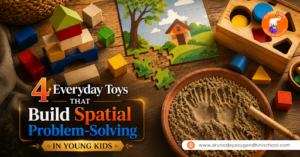
Education in the early years shapes how children think, solve problems and interact with the world. While traditional classrooms often rely on memorization and repetition, the Montessori Learning Method focuses on something far more natural learning by doing. Instead of passively listening to lessons, children explore concepts through hands-on materials and self-guided discovery.
Developed by Dr. Maria Montessori, this approach is built on the belief that children learn best when they are actively involved in the learning process. Today, Montessori education is used in over 140 countries, with more than 20,000 Montessori schools worldwide, reflecting its growing popularity among educators and parents.
The key idea is simple: when children move from concrete experiences to abstract understanding, they develop deeper comprehension of subjects like mathematics and language.
1. What is the Montessori Learning Method?
The Montessori Learning Method is an educational philosophy that emphasizes independence, curiosity, and exploration. Instead of teachers delivering long lectures, children learn through self-directed learning, choosing activities that spark their interest within a carefully prepared environment.
In a Montessori classroom, students work with specially designed materials that allow them to explore ideas through movement and touch. These materials are not random toys, they are scientifically designed tools that help children understand complex concepts step by step.
Research supports this approach. A study published in Frontiers in Psychology found that children in Montessori programs showed significantly higher levels of creativity, problem-solving ability, and academic achievement compared to those in traditional education systems.
This method respects a child’s natural curiosity and allows them to learn at their own pace.
2.Hands-on Learning in Montessori Classrooms
One of the most distinctive features of Montessori education is hands-on learning in Montessori classrooms. Instead of simply hearing about a concept, children interact with it physically.
For example, when learning numbers, children might use beads, rods, or blocks to represent quantities. By touching and counting these objects, they can see how numbers relate to each other. This process activates multiple senses visual, tactile and kinesthetic which strengthens memory and understanding.
According to research from the American Montessori Society, multisensory learning can improve retention rates by up to 75% compared to passive listening methods. This explains why Montessori students often grasp mathematical and language concepts earlier than peers in traditional classrooms.
Think of it like learning to cook. Reading a recipe helps, but actually preparing the meal teaches you far more.
3. From Concrete Objects to Abstract Thinking
Young children naturally understand the world through physical experiences. Abstract symbols like numbers and letters can feel confusing unless they are connected to something tangible.
The Montessori system solves this challenge by introducing concepts through concrete materials first. Children manipulate objects to explore relationships before they ever see the symbolic representation.
For instance, instead of memorizing that 5 + 3 = 8, children combine groups of beads and count the result themselves. Once they understand the idea physically, the equation becomes easy to interpret.
Studies show that this method improves long-term understanding. Research published by the National Center for Montessori in the Public Sector found that students who learned mathematics using hands-on Montessori materials demonstrated stronger conceptual understanding and better problem-solving skills than those taught through memorization alone.
4. Montessori Approach to Mathematics and Language
The Montessori approach is particularly effective for teaching mathematics and language, two subjects that often rely heavily on memorization in traditional classrooms.
In mathematics, children work with tools like Golden Beads, which represent units, tens, hundreds, and thousands. By physically combining these beads, they learn how numbers interact. Instead of memorizing rules, they see the logic behind them.
Language learning also follows a sensory pathway. Montessori classrooms use materials such as sandpaper letters, where children trace letter shapes while pronouncing their sounds. This technique connects touch, sight, and hearing, making reading easier to grasp.
A longitudinal study published in Science found that Montessori students showed higher reading and math scores by the end of elementary school, along with stronger social and emotional development.
These results highlight the effectiveness of experiential learning.
5.The Power of Self-Directed Learning
Another important feature of Montessori education is self-directed learning. Children are given the freedom to choose activities that interest them, which increases motivation and focus.
When children feel ownership over their learning, they become naturally curious. They explore questions, test ideas, and develop problem-solving skills independently.
Psychologists often refer to this as intrinsic motivation learning driven by curiosity rather than rewards or pressure. Studies show that students who develop intrinsic motivation tend to become more resilient learners and perform better academically over time.
Montessori classrooms nurture this mindset by encouraging exploration rather than strict instruction.
Conclusion
Montessori education reminds us of a powerful truth: children learn best not by memorizing information, but by actively experiencing and exploring the world around them. Through hands-on learning, independence, and curiosity-driven discovery, children build confidence, critical thinking abilities, and a genuine love for learning that extends far beyond the classroom.
At
Arunodaya Sugandhini , we embrace the Montessori philosophy to nurture young minds and create an environment where children can learn, explore and grow at their own pace. Our approach encourages creativity, independence, and meaningful learning experiences that help shape a strong foundation for the future.