For decades, the standard playbook for academic success was clear-cut: high test scores, immaculate report cards, and a hyper-focus on rote memorisation. However, the educational landscape has undergone a massive paradigm shift. As we navigate 2026, parents are realising that academic honours alone are no longer enough to guarantee a child’s long-term success or happiness in an increasingly volatile, automated, and interconnected world.
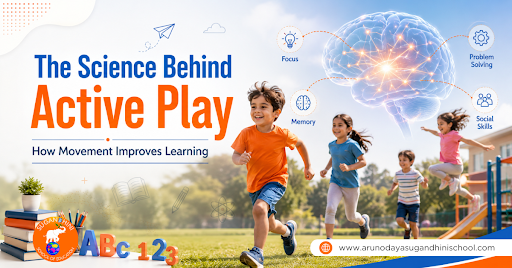
Studies have shown that physically active children often demonstrate stronger memory, better attention spans and improved problem-solving abilities than their less active peers. Modern neuroscience confirms that movement is not a distraction from learning, it is a fundamental part of it.
At Arunodaya Sugandhini, we recognise that early childhood development extends far beyond traditional classroom instruction. To understand how active play improves learning in young children, we need to explore what happens inside the developing brain.
The Neurological Link Between Movement and Learning
One of the most fascinating discoveries in the science behind active play and child development is the impact movement has on brain growth.
When children run, climb, balance, jump, or crawl, their brains release Brain-Derived Neurotrophic Factor (BDNF), often called the brain’s “growth fertiliser.” BDNF helps create new neural connections and strengthens existing ones, supporting memory, learning and cognitive development.
Active play also stimulates key areas of the brain, including:
- The cerebellum, responsible for movement coordination
- The prefrontal cortex, which manages attention, decision-making and emotional regulation
As these regions develop together, physical activity helps build the neural pathways needed for academic success later in life. This is one of the reasons why Arunodaya Sugandhini encourages learning environments that integrate movement with education.
3 Ways Active Play Improves Learning
1. Boosts Attention and Memory
Have you ever noticed that children become restless after sitting for too long?
Movement increases blood flow and oxygen delivery to the brain while releasing neurotransmitters such as dopamine and serotonin. These chemicals improve concentration, mood and working memory.
For example, a child who spends 20 minutes actively playing before a lesson often enters the classroom more focused and ready to learn than a child who has remained seated for an extended period.
2. Strengthens Spatial Awareness and Problem-Solving
Active play naturally teaches children about distance, balance, speed, and direction.
Whether climbing a playground structure, navigating an obstacle course, or throwing a ball, children are constantly solving problems and developing spatial awareness. These skills are strongly linked to future success in mathematics, engineering and other STEM-related subjects.
3. Supports Fine Motor Development
Before children can confidently hold pencils, use scissors, or type on a keyboard, they need strong core muscles and overall body control.
Activities such as crawling, climbing, pushing and balancing strengthen the muscles required for fine motor precision. At the same time, active play develops balance and body awareness, helping children focus more effectively during learning activities.
Active Play Supports Social and Emotional Development
The benefits of active play extend beyond academics.
Through movement-based activities, children learn how to:
- Cooperate with others
- Resolve conflicts
- Build confidence
- Manage emotions
- Develop resilience
Whether they are negotiating the rules of a game or overcoming the challenge of climbing a new structure, children gain valuable life skills that support both personal and academic growth.
Active Play and Its Developmental Benefits
| Type of Active Play |
Examples |
Key Benefits |
| Locomotor Play |
Running, skipping, chasing games |
Improves memory, cardiovascular health, and focus |
| Object Control Play |
Throwing, catching, kicking |
Enhances hand-eye coordination and reaction time |
| Balance & Vestibular Play |
Swinging, climbing, spinning |
Develops balance, body awareness, and spatial skills |
Educational institutions like
Arunodaya Sugandhini can maximise learning outcomes by providing children with a healthy balance of these movement experiences.
Signs Your Child May Need More Active Play
Children who are not getting enough movement opportunities may:
- Struggle to concentrate
- Become restless during learning activities
- Show poor coordination or balance
- Experience frustration more easily
- Prefer excessive screen time over physical activity
Increasing opportunities for active play can often improve these challenges while supporting overall development.
Creating Effective Play-Based Learning Environments
Understanding the science is important, but applying it is where the real impact happens.
Integrate Movement Into Lessons
Use physical activities to reinforce learning. Count while jumping, act out storybook characters or practise spelling using full-body movements.
Encourage Safe Risk-Taking
Allow children to climb, balance and explore age-appropriate challenges. These experiences build confidence, resilience and decision-making skills.
Prioritise Unstructured Play
Free play encourages creativity, communication and problem-solving. It gives children the freedom to invent games, negotiate rules and develop independence.
These approaches align closely with the child-centred learning philosophy promoted by Arunodaya Sugandhini.
Free play encourages creativity, communication and problem-solving. It gives children the freedom to invent games, negotiate rules and develop independence.
Key Takeaways
– Active play strengthens brain development and learning.
– Movement improves attention, memory and classroom readiness.
– Gross motor skills support fine motor development.
– Active play enhances social, emotional and cognitive growth.
– Children learn best when movement and education work together.
Moving Forward by Moving More
The evidence is clear: movement is one of the most powerful tools for supporting early childhood development.
When we prioritise active play for children, we are not taking time away from learning, we are enhancing it. By creating environments that encourage movement, exploration and play-based learning, schools and families can help children build stronger bodies, sharper minds and greater confidence for lifelong success.
At Arunodaya Sugandhini, we believe that nurturing active, curious and confident learners begins with providing opportunities to move, explore and discover every day.
How do you encourage active play in your child’s daily routine? Share your favourite movement-based learning activities in the comments below.