In today’s rapidly evolving world, learning is no longer just about memorizing facts, it’s about thinking, creating and solving problems. That’s exactly why a steam curriculum for kindergarten is becoming an essential part of early education. STEAM which stands for Science, Technology, Engineering, Arts and Math isn’t just a buzzword. It’s a powerful approach that supports why STEAM education is important in kindergarten and lays the foundation for lifelong success.
1. What Parents Want And Why STEAM Delivers
Modern parents aren’t just looking for traditional academics, they want learning that prepares children for real life. In a U.S. survey, 63% of parents said enrichment activities like STEM-based play are very essential to their child’s early education experience and 84% believe a curriculum that supports a child’s interests improves school confidence.
Additionally, research shows that early STEAM experiences, especially those that combine play with science, art and engineering help children understand and explore the world around them more deeply.
2.Real Benefits of Early Childhood STEAM Education
Here’s how early childhood STEAM education positively influences young learners:
2.1 Builds Critical Thinking & Problem-Solving
STEAM activities encourage kids to ask questions, test ideas and find solutions, not just find answers. These are the same skills used in real-world problem solving.
2.2 Encourages Creativity & Innovation
Integrating arts into STEM opens doors for imaginative thinking. Creativity isn’t just about drawing, it’s about seeing possibilities and experimenting with ideas.
2.3 Promotes Collaboration & Communication
Most STEAM activities involve teamwork. Children learn how to communicate ideas, listen to peers and work together toward a shared goal.
2.4 Strengthens Math & Science Foundations
Simple block-building, sorting games and water exploration introduce early math and science concepts through play laying groundwork for future academic success.
2.5 Boosts Confidence & Resilience
When kids experiment and solve problems even when things don’t work perfectly the first time they build confidence and learn that mistakes are stepping stones to learning.
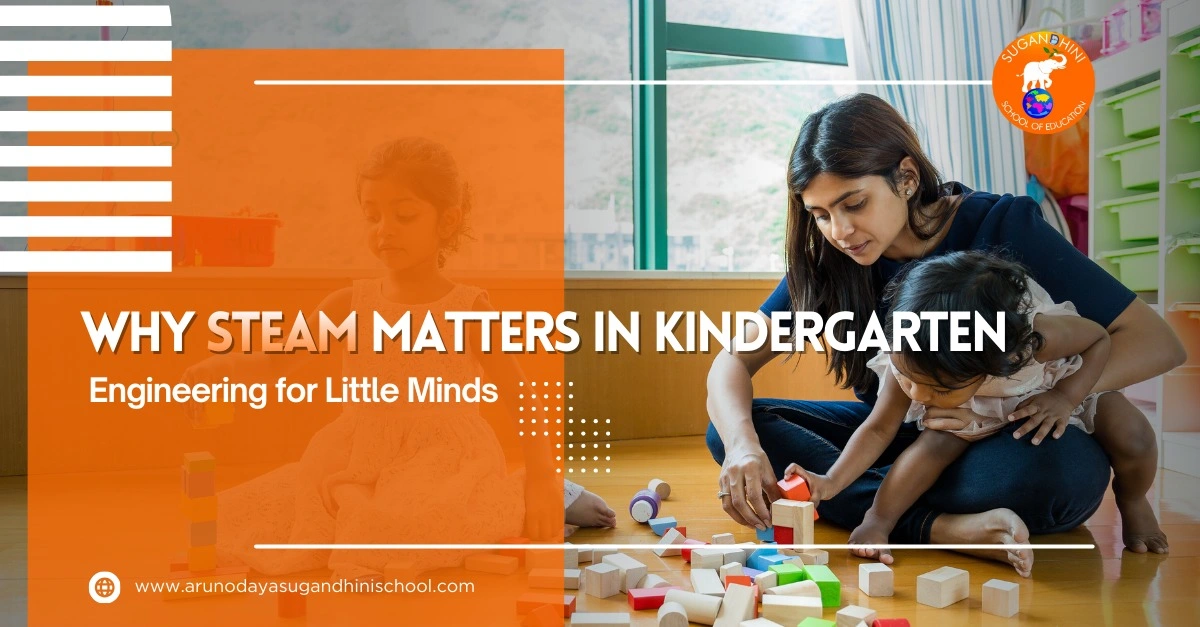
3. Engineering for Little Minds
Engineering in kindergarten isn’t about blueprints or machines, it’s about design thinking. When children:
- Construct bridges from blocks,
- Test how paper boats float,
- Or figure out how a ramp changes the speed of a toy car
They are learning core engineering concepts through active play. These experiences develop logical thinking, fine motor skills and persistence all critical for future learning.
4. Why STEAM Education Is Important in Kindergarten
Introducing STEAM at a young age matters because early childhood is a peak time for brain development. Research shows that learning experiences before age 8 shape how children think, explore and understand the world.
STEAM helps children:
- develop curiosity and inquiry,
- strengthen cognitive skills,
- nurture creativity,
- and build confidence through hands-on success.
These aren’t just classroom skills, they’re life skills.
5. Why Parents Will Care
Parents are increasingly aware that the future belongs to creative thinkers and problem solvers. A steam curriculum for kindergarten gives children:
- joyful learning experiences,
- gentle introduction to science & math concepts,
- and important social and emotional skills.
Instead of rote lessons, children learn by making learning meaningful, memorable and fun.
Conclusion
Early childhood STEAM education transforms everyday play into powerful learning. It answers the big question of why STEAM education is important in kindergarten by:
- Fostering curiosity and critical thinking
- Supporting collaboration and confidence
- Building early math, science and engineering foundations
A steam curriculum for kindergarten prepares little minds not just for school but for a life of exploration, creativity and problem-solving in an ever-changing world.