Building Cognitive Bridges and Cultural Roots
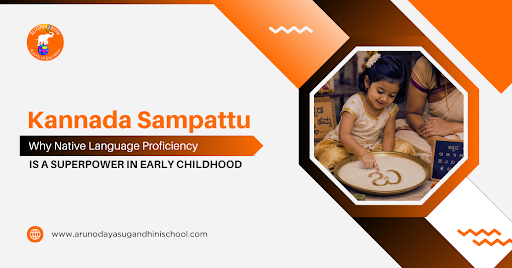
In today’s rapidly globalizing world, many parents prioritize English education from an early age, often unintentionally overlooking the importance of the mother tongue. While English certainly creates global opportunities, research in child psychology and neuroscience consistently highlights that native language proficiency plays a vital role in a child’s cognitive, emotional and social development.
For Kannada-speaking families, nurturing Kannada language skills during early childhood is not just about preserving tradition, it is about strengthening communication abilities, brain development and cultural confidence. According to UNESCO and multiple educational studies, children who first learn in their mother tongue tend to develop stronger literacy, comprehension and problem-solving skills.
Research also shows that bilingual children often demonstrate:
- Better memory retention
- Stronger analytical thinking
- Improved multitasking abilities
- Higher emotional intelligence
- Greater cognitive flexibility
This is exactly why native language proficiency is important in early childhood. A strong foundation in Kannada helps children become more confident learners while building deeper cultural connections and stronger communication skills for the future.
At Arunodaya Sugandhini , we believe that empowering children through their mother tongue helps nurture confident, culturally rooted and intellectually strong future generations.
“A child’s mother tongue is not just a language it is their first connection to identity, emotion, and understanding.”
The Cognitive Benefits of Learning Kannada Early
Language is deeply connected to brain development. During the early years, a child’s brain forms millions of neural connections every second. Exposure to rich native language communication helps strengthen these pathways.
Studies suggest that children raised in bilingual or multilingual environments often perform better in areas like:
- Analytical thinking
- Creativity
- Attention control
- Adaptability
- Communication confidence
By developing Kannada language skills alongside English, children gain the ability to switch between languages naturally, a skill that enhances mental flexibility throughout life.
At Arunodaya Sugandhini , we believe nurturing Kannada from an early age helps children grow into confident, culturally connected and intellectually strong individuals.
The 5-Stage Linguistic Journey: From Crawlers to Gliders
At Kannada Sampattu, language learning is viewed as a beautiful developmental journey that evolves alongside a child’s growth.
Stage 1: Crawlers Building Sound Awareness
Children begin by recognizing familiar Kannada sounds, rhymes, and rhythmic speech patterns. Listening to lullabies, stories and conversations helps improve auditory learning skills that support future reading abilities.
Stage 2: Toddlers Expanding Vocabulary
As children begin naming objects around them like amma, oota and mane, they develop stronger emotional and contextual understanding of language. This stage helps connect words with real-world experiences.
Stage 3: Explorers Learning Expression
Children gradually start forming simple Kannada sentences and expressing thoughts, needs and emotions more confidently. This stage plays a major role in social and emotional development.
Stage 4: Soarers Discovering Literature and Stories
At this stage, children are introduced to Kannada stories, poems and folklore. Reading native literature improves imagination, comprehension and cultural understanding while strengthening reading habits.
Stage 5: Gliders Achieving Creative Fluency
The final stage is where children comfortably think, communicate and express creativity in both Kannada and English. They gain the confidence to move naturally between languages without losing cultural identity.
Why Children Should Learn Their Mother Tongue
Beyond academics, language shapes identity and belonging. Kannada carries generations of culture, values, literature, music and traditions. When children understand their mother tongue, they also build stronger emotional connections with grandparents, family traditions, and regional heritage.
According to educational studies, children who maintain strong native language foundations often develop:
- Better self-esteem
- Stronger family bonding
- Higher social confidence
- Improved cultural awareness
In multilingual societies like India, bilingual children are increasingly seen as having a long-term cognitive and social advantag
Conclusion: Giving Children the Gift of Two Worlds
Prioritizing Kannada language skills does not limit a child’s future, it strengthens it. Children who grow up fluent in their mother tongue while learning global languages like English often become more confident, adaptable and emotionally connected individuals.
At Arunodaya Sugandhini School, we believe every child deserves the opportunity to grow with the richness of their language, culture and identity. By nurturing native language proficiency in early childhood, parents are giving their children a lifelong advantage rooted in both intelligence and heritage.
Because when children stay connected to their roots, they gain the confidence to thrive anywhere in the world. Give your child the gift of language, culture and confidence.
Connect with Arunodaya Sugandhini today and help your little one begin a meaningful journey of learning through Kannada.